Teaching
Click to Download the provisional Syllabus or the reading guide
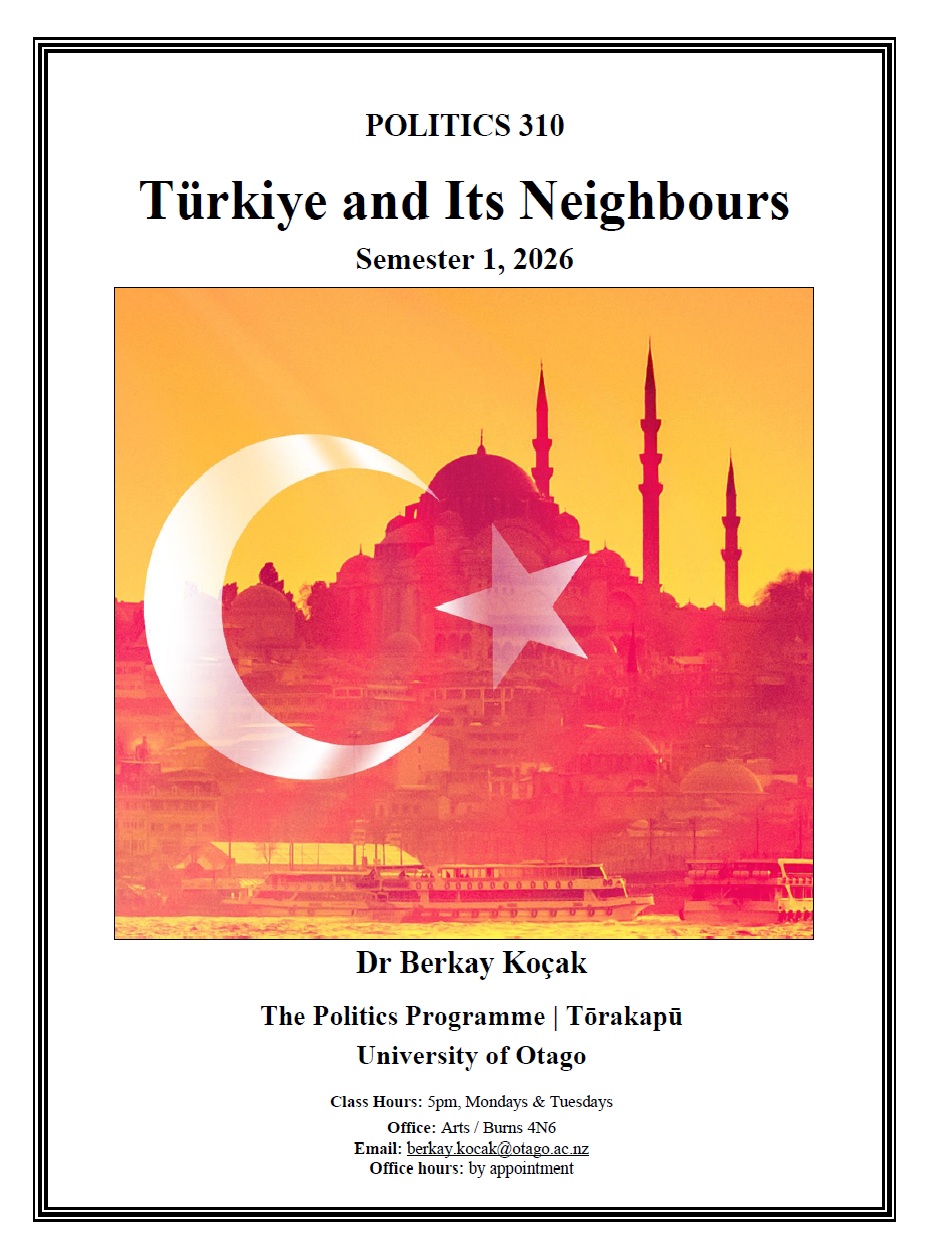
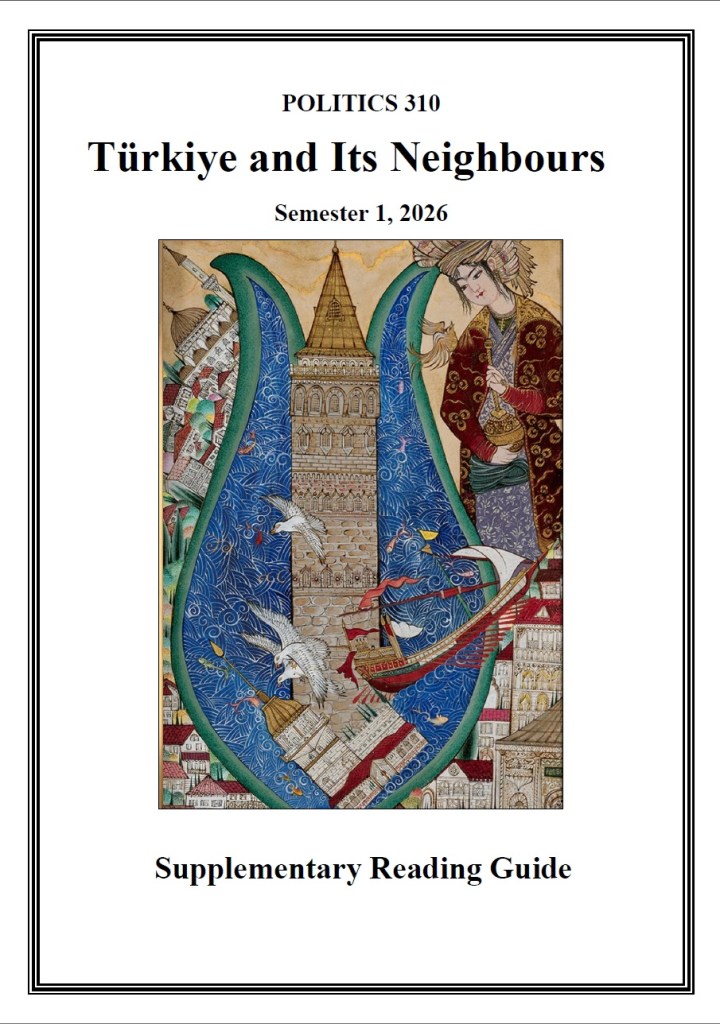
POLS310 – Türkiye and Its Neighbours
University of Otago (2026)
This paper, Türkiye and Its Neighbours, examines the making and transformation of modern Türkiye through an integrated study of political history, political economy, and international relations. While Türkiye is the core case, the course provides students with a broader analytical toolkit for understanding how states and regimes are formed, contested, and reshaped in a changing international order. It explores how nation-building, state transformation, social and political movements, and geopolitical tensions interact in the production of a distinctive, multi-engaged and multi-aligned country positioned at the intersection of Europe and the Middle East, Atlantic alliances and Eurasian powers, and the institutional worlds of both the Global North and the Global South.
Previous Teaching
Click to Download Syllabuses

POLSC101 – Politics in the Ancient World
The University of Waikato (2019-2020)
This course offers an interdisciplinary approach to examine the major developments of Ancient Greek and Roman political thought with a focus on the ideas of a number of political thinkers and political systems of Athenian democracy, and the Roman republic/empire. We begin with a brief introduction of the political systems in the widely divergent historical contexts in Greece, and Rome, exploring the processes of social change that characterized foundations of political thought. After politicizing the terrains of engagement of ancient political thinkers, attention turns to contextualize their political thought in their own historical setting. The objectives of the course are to introduce students to the history of political ideas in the Western political tradition from 500 BC-1500 AD, and to offer them an interdisciplinary method to critically consider political theory in relation to social change in different historical contexts.
POLSC201 – Modern Political Thinkers
The University of Waikato (2019-2020)
This course offers an interdisciplinary approach to examine the major developments of European political thought with a focus to the ideas of a number of political thinkers in the modern era: Machiavelli, Hobbes, Locke, Rousseau, Hegel and Marx. We begin with a brief introduction of the social transformations in the widely divergent historical contexts in Italy, England, France and Germany exploring the processes of social change that characterized modern foundations of political thought. After politicizing the terrains of engagement of modern political thinkers, attention turns to contextualize their political thought in their own historical setting. The objectives of the course are to introduce students the history of political ideas in the Western political tradition from 1500-1900, and to offer them an interdisciplinary method to critically consider political theory in relation with social change in different historical contexts.

POLS208 – Democracy: Past, Present, Future
University of Otago (2022)
This course provides a forum for rethinking and discussing the past, present and future of democracy. It focuses on three major models of democracy that have emerged thus far in history: Athenian democracy, liberal representative democracy, and socialist participatory democracy. The course is organised into four sections focusing on these forms of democracy and many subsections to compare and contrast different examples of democracies all around the world.

POLS310 – Turkey and Its Neighbours
University of Otago (2023)
This course examines the political economy and international relations of modern Turkey. The course provides a contextual analysis of Turkey’s contemporary politics, its social movements, and its political history in the light of its political-economic regime. It explores complexities and tensions at the meeting point of the West, Islam, and the Middle East and a variety of ethnic identities – Turks, Greeks, Armenians, Kurds, Arabs and more. It reviews Turkey’s interactions with both its turbulent neighbourhood and the wider world.
Sample Lecture
Berkay Koçak, PhD
Political Scientist & Policy Analyst
 Berkay Koçak, PhD